Interview with Jason Skoog - Part 1
Kari: We are so excited because we have a very special guest speaker today, Jason Skoog, and his company is Foundational Skills Development and Equine Center. And it's kind of neat for myself. I've been with Jay for a very, very long time because his wife actually became certified at the Equine Connection. She then really wanted her husband to be a part of the Equine Connection.
So then Jason came in. And then from that, we have actually worked with Jay for our farrier work, who's absolutely amazing. But one of the most exciting things that we have now done with Jay is a training component with our horses, which is most exciting because it falls in line with Chris Irwin as well, and the body language and the three energies.
So welcome, welcome, welcome. Jay, how are you doing this morning?
Jason: I'm doing great.
Kari: Good to hear. So tell us, like, what the heck in all of this that you were doing? Because you were kind of like a horse jack-of-all-trades, if you will. You are definitely a horse-preneur. Tell us something about how your journey has gone to where you are now. What is it that you're offering at your business?
Jason: Well, it started out as just a small idea that we thought maybe we would get into. And everybody told us you can't make money working with horses. You can't make a living working with horses. And so that mantra was kind of always playing in the back of my mind. That was my internal battle. And I'm happy to say it's not true.
So, as you know, we originally just knew that we loved working with horses. And every time we worked with them, we took away way more than horsemanship, way more than some skills, way more than working at any other trade or occupation that I had been involved in. And I mean, every kid with a horse understands what I'm talking about. When you're having a tough day and you go out there and you just spend time with your horse, you come away, you just feel better.
So our main goal was to be able to share that with others. We wanted others to be able to experience whether they owned a horse or not, and to take that forwards. And that was the why behind doing it, other than the personal benefit of just working with horses every day is amazing as well.
So we kind of started into this journey dabbling and we got some horses and we began doing some riding. I grew up on a farm, so it wasn't new for me. My wife, Amber, of course, she grew up having horses in her life. But when we first got married, we had horses for a little bit and then when we had kids, we sold our horses because we weren't spending any time with them.
And so we were away from it for a few years and then decided that that was a missing piece in our life and got back into it. And it was, also it has been deeply fulfilling. As anything that's near and dear to our hearts, also really difficult at times too, because of how badly you want something to work out. And sometimes when you're emotionally tied to something like that, you put your own roadblocks in the way.
Kari: Isn't that the truth?
Jason: So in the beginning, we started out just offering some riding lessons. Some people had approached us and we started offering that. Then a good friend of mine, Marine Snow, asked if I would instruct at her barn. So I did some riding lessons at her barn for her. Then through COVID, I think it was 2017 that we certified as EAL facilitators and started pursuing that path with horses as well.
Through COVID, I couldn't instruct at the barn anymore because things were shut down and then opened up. Sometimes they were okay and sometimes they weren't. It was a little bit flippant. But what happened was we ended up, when things were available for us to work outdoors, we just started doing more from home and decided that was the avenue to take.
Also, with Equine Assisted Learning, because we had landed a contract with a school division nearby, we were able to run those programs as well. With precautions in place and stuff because it was a curriculum program, which was really nice. Schools were running it as a curriculum.
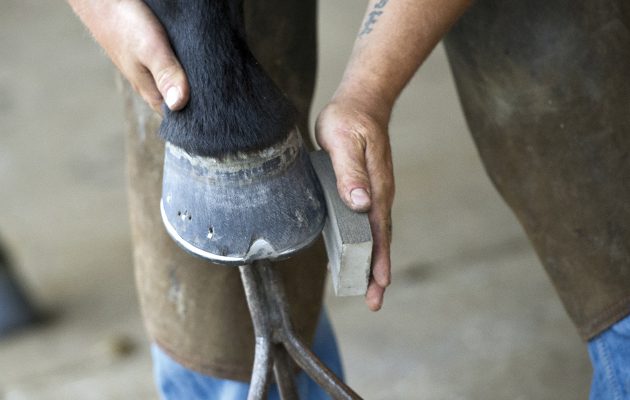
Away we went. Farrier work, I accidentally got into. That was never something that was on my radar to do. I had always trimmed my own horses, except for a few times. Occasionally I would hire another farrier to come out so I could have them check my work and learn from them as well. I always asked if I could watch and learn and they were always good to me that way.
So I had a variety of different farriers come trim my horses over the years and shoe them. But at one point in time, I decided that I was tired of hiring farriers that could shoe well but didn't handle the horses the way I wanted them handled when any kind of undesirable behavior came up. I'm not disillusioned, my horses aren't perfect.
I think they're great, but they're not perfect. Sometimes they did give the farriers some grief and I wasn't happy with the response that happened there. I thought it was ridiculous that I would have to go out afterwards and then retrain my horse afterwards. They were pretty good with their feet. Again, not perfect, but pretty good where I could do them. That's coming from a point of doing them myself rather than having somebody else come in and fight with them.
So there was a gap there that I wanted to close. I did a farrier certification course at this point in time. Bear in mind that I had already had years of experience doing farrier work, just trimming at that point. And so I went specifically to learn more about shoeing.
When I got back, I remember before I left actually, a neighbor of mine said, "Are you gonna start shoeing other people's horses?" And I said, "Not on your life." I went to the course and actually really loved it. I was so sore at the end of it that I couldn't bend over to lace my boots up. Anyway, despite that, it is a very rewarding career and I'm very passionate about it and passionate about making the horse better as a whole, not just the feet.
Kari: Yeah, I have to say, that's the biggest thing that the connection that we have with you is again, by even being self-aware of you being self-aware of how you interact with our horses. And that's what, well, our hearts melt because no matter what, it's not like you're a little pony, it's okay. You give the horses what they need to stay safe, and they need to stay safe by having that strong leadership and everything you do, which did, it helped in the behavior to me with our horses because you were always about them first.
And I mean, for all of us in farrier world, horse world, we know it is so flipping hard to find that great farrier. So you're not allowed to die. And even though I always say you can die any day, any moment, but you're just not allowed to. You and Grant McKinnon, not allowed to. I appreciate that, I think.
So it's so cool because I know before you were a welder, were you not by trade?
Jason: I was a welder for eight years and I was a motorcycle mechanic for 15 years before that and a farmer. So I think that probably the farmer's son is where the different occupations come from.
Kari: Wow, it's so exciting even as I'm hearing your story. Like I just find when you're really set and you're ready to rock and roll in the world of horses where everyone says you cannot make a living doing it and you just take that one step forward, just that one action piece. The path continually opens in this incredible world, being with the horses. And it's so exciting to hear your path because then you still even have another component. You have many components in the equine world and it's kind of neat.
That's why you call yourself an equine center as well because you can hit so many of those pieces that you're helping others with, right?
Jason: Yeah, and with everything that I've done, some people would agree and some people would disagree, but I've always liked having multiple disciplines and multiple teachers. I know I've been told over the years that the waters can get muddy when you have so much different input. But I think the important part to remember with that is that if you draw from those different teachers and you don't just take skills necessarily, or, oh, what's the word? That's something that you would do to correct.
So let's say you have a problem and then somebody offers a solution and you just connect like that. If you can look at all of those different teachings and all those different skills and tools and draw principles, then I think it works. I had multiple phenomenal teachers when it came to mechanicing and the knowledge base that I didn't realize I had until later in my career turned out to be amazing. That's directly because I had multiple good teachers and I was able to draw from all of them. So I didn't just have wisdom from one great mechanic, I had wisdom from many great mechanics and it helped me out a lot.
Kari: And you really brought it all together to make it a part of life.
Jason: Yes, and I think that's really great advice for many because lots of times people continually keep taking those knowledge base clinics or trainers that they're working with and then they think they have to change their whole system of what it is that they're doing where taking a little bit here, a little bit from this one, oh, I connect with the way that Warwick has done similar. Like it's beautiful to kind of make your own world with it as long as the number one is, it's for the benefit and the welfare of the horse.
As long as we're always doing that, it's a win-win but then don't get overwhelmed with taking so much stuff that you actually don't implement anything because that would be just like being in a business. You can take it all but once you start getting too overwhelmed, then it's like you don't do anything because it's too much.
Kari: I agree, Warwick Schiller is a great example of somebody who calls himself a connector. He's amassed information and put it together and developed the principles of training, which I love. And he's a great example of how that type of learning can work. He's very successful and a great role model.
Jason: Yeah. I always say, to just corroborate what you said about amassing a bunch of knowledge and not being able to move forwards. I've always said the hardest step when you're going to the gym is the first step. Because as soon as your feet are moving, then you gain momentum and you're okay. But to take the first step, that's the tough one.
Kari: Absolutely, pow. That was a good one. I like that. Good metaphor. So Jay, tell us a little about your training. Are you open for others to take part in your training with the horses in the horsemanship component, or are you just fiddling with that?
Jason: No, I just moved or I'm in the process of moving.
Continued...Part 2